Monday, March 26, 2018


UNDER EVALUATION
EDUC 6165

Image result for communication in early years

 I CAN BLOG ABOUT WHO I AM, WHAT I LIKE TO DO, AND TELL STORIES OF MY FAULTS, EMBARRASSMENTS, WEIRD MISHAPS, AND EVEN ACCOMPLISHMENTS. BY BLOGGING ABOUT MYSELF IT WOULD PROVIDE ONLOOKERS IDEA OF HOW I INTERACT AND COMMUNICATE DURING EVENTS OR HOW I COMPOSE MYSELF. THROUGH MY EYES- MY STORIES- IT’S EASY FOR ME TO EVALUATE MYSELF, BUT WHAT IF SOMEONE ELSE SHINES NEW LIGHT TO WHO YOU THOUGHT YOU WERE WHEN THEY EVALUATE YOU?...


TAKING A SELF-ASSESSMENT QUIZ THIS WEEK REGARDING COMMUNICATION I WALKED AWAY CONFIDENT IN THE WAY I INTERACT WITH OTHERS. UNDER EVALUATION BY FAMILY AND COWORKERS RESULTS WERE SURPRISINGLY SIMILAR. BUT IF THAT WAS NOT THE FINAL APPEAL WHAT IF RESULTS WERE VASTLY DIFFERENT? PERSPECTIVE OF MYSELF WOULD CHANGE, BEHAVIOR WOULD CHANGE, AND EVEN MY APPROACH OF EVENTS AND PEOPLE WOULD CHANGE. OH, ABSOLUTELY!

Image result for communication

WITH THAT IN MIND, IT IS IMPORTANT THAT WE COMMUNICATE WHETHER OR NOT IN THE FIELD OF EARLY CHILDHOOD IN A WAY THAT OTHERS CAN DETERMINE OUR REASONS OF INTERACTION AND COMMUNICATION. WE HAVE TO MAKE SENSE. WE DO NOT WANT TO EXCHANGE MIXED SIGNALS OR MESSAGES THAT COULD EFFECT AN ANTICIPATING OUTCOME. FINDING NEW LIGHT UNDER EVALUATION, I HAVE RECOGNIZED THAT HOW PEOPLE SEE ME BOTH PERSONALLY AND PROFESSIONALLY HAS EVERY IMPLICATION OF THE TYPE OF COMMUNICATOR I AM. WITH LITTLE ANXIETY, “SOFT” AGGRESSIVENESS, AND FINE LISTENING SKILLS I AM GLAD THAT OTHERS AGREE. THIS HELPS MY JOURNEY IN THE FIELD OF EARLY CHILDHOOD EDUCATION AS AN EFFECTIVE COMMUNICATOR. WHAT A RELIEF!...

Image result for teachers and kids


Monday, March 19, 2018


WHAT WE PERCEIVE AND LEARN FROM CULTURALLY
EDUC 6165

Image result for cultural communication

“In our diverse world, perceptual challenges can present barriers to competent communication, including narrow perspectives, stereotyping, and prejudice” (O’Hair, et al., 2015, pg. 43).
It is hard to ignore the fact that some people (or a lot of people) communicate with me differently because maybe I’m white, maybe I am female, speak English, and have brown hair/green eyes. I see people all the time, every day interacting a lot. Agoraphobia is NOT in my nature… But maybe it’s me? Maybe I am the one struggling to communicate with others… HUMMM?
I live in Houston Texas. With a diverse population, culture is undoubtfully here. I see myself struggling to communicate when I don’t understand another person’s language. Just last week, I went to the hospital to see my friend who just had a baby. I couldn’t find an entrance to the hospital because of all the construction so I asked a worker where to go. He looked at me as I repeated myself. All of a sudden he said, “No Engles” which indicates he doesn’t speak English. Then it got awkward. I walked away saying, “Gracias” still lost. Due to cultural differences and a lack of knowing each other’s languages, communication was difficult BUT I did find my friend and her baby.
From this experience, I do find myself communicating differently but it’s because I am aware, I try to get my “S.O.S” or message across somehow with as much knowledge and curtesy as I can give. I want to learn of other cultures and I know I live in a diverse world so with encounters like this I can only laugh at myself and accept differences.

Image result for getting lost

Strategies to Communicate Better:

  Karl Krayer
  • 1)      Be mindful
  • 2)      Respect
  • 3)      Be accurate with personal perception  (O’Hair, et al., 2015)
Image result for early childhood communication development
Janet Gonzalez-Mena

  • 1)      Look through other’s eyes
  • 2)      Be open minded
  • 3)      Be accepting            (Gonzalez-Mena, 2010)

Related image

These strategies by Krayer and Gonzalez-Mena help families and professionals communicate better when diversity is a trend –not an obstacle. Cultures coincide. I have found these strategies noteworthy and revolutionizing in order to improve my communication skills whether in a classroom or figuring out where the entrance is to a building.

Works Cited
O’Hair, D., Wiemann, M., Mullin, D.I., & Teven, J. (2015). Real Communication (3rd Ed.). New York, NY: Bedford/St. Martin’s

Gonzalez-Mena, J. (2010). 50 Strategies for Communicating and Working with Diverse Families. Upper Saddle River, NJ: Pearson Education, Inc.

Tuesday, March 13, 2018


I LOVE LUCY
EDUC 6165
Image result for i love lucy

I Love Lucy is an iconic 1950’s television sitcom that has impressed all types of audiences for decades. Lucille Ball is one of my most beloved actresses that I see as a great communicator both on screen and off. According to biographies and other literatures written about Lucille Ball she was the first successful lady in television history to become shared CEO of Hollywood’s Desilu Productions alongside her husband Desi Arnaz producing and acting in many of their own films. “Desi-Lu”… get it? LOL!
The purpose of this blog is to find what sort of communication skills and styles characters display on television with or without sound. What better example for me than using Lucille Ball and husband Desi Arnaz who once starred in the boundless sitcom, I Love Lucy. This is what I have determined…
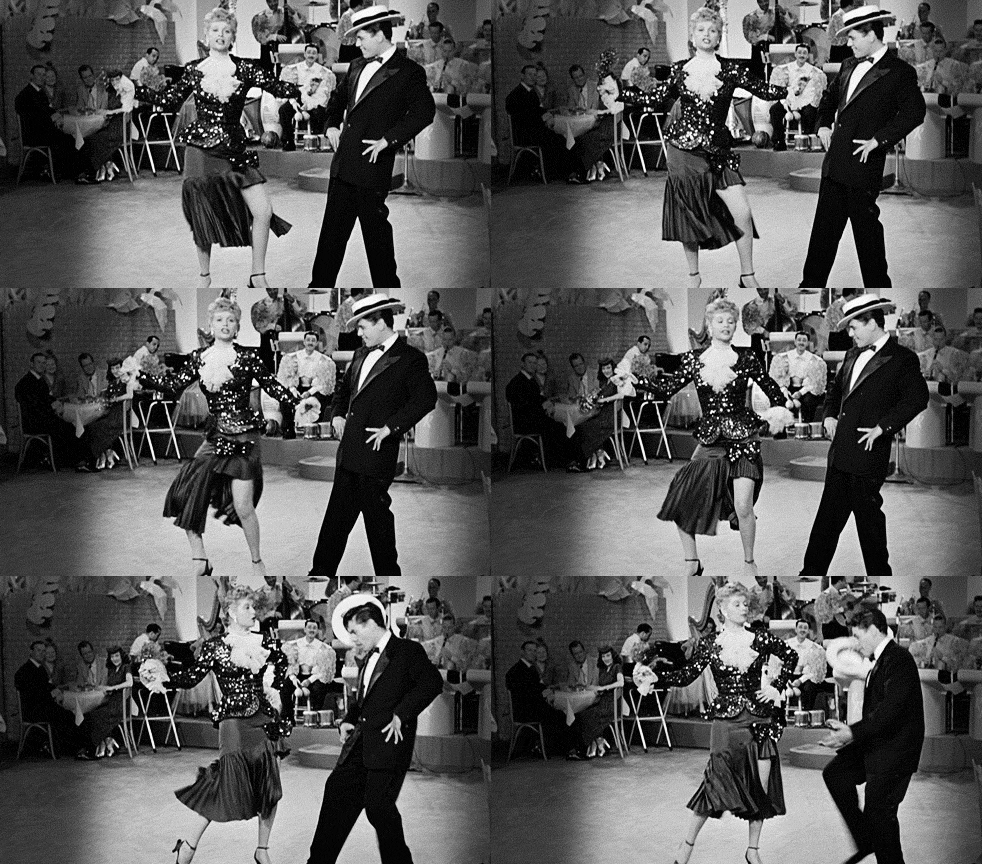
I Love Lucy’s season 1 episode 3, “The Diet” (1951) illustrates zany Lucy (Ball) who wants to shed weight so that she could perform in Ricky’s (Arnaz) night club finding her spot in show business (ironic, right?). After 4 days of diet and exercise, even though she was not nominated, Lucy managed to fit the required dress for the performance then sneaking on stage to sing and dance to “Cuban Pete”-originally sung by Louis Armstrong in 1937- with Ricky who was surprised it was her in the dress and it was her as his partner.
Image result for i love lucy the diet
Body movement is nonverbal
Image result for i love lucy the diet
Facial expressions are nonverbal
Image result for i love lucy cuban pete
Signaling is nonverbal
 
The communication I find intriguing during this particular episode is based on what authors, Dan O’Hair and colleagues (2015) suggest as nonverbal communication. With or without sound, I see where this is relevant. Moreover, according to Dan O’Hair and colleagues (2015) nonverbal communication involves no words so engagements like signaling, emotions, body movements, etc. are apparent as I watch Lucy take on diet, exercise, and performance. Her nonverbal communication such as her body movements display fatigue in her posture as she runs around her apartment, her emotions in her face show determination to lose weight (either that or her tongue hanging out as everyone eats a juicy steak in front of her. Poor Lucy is stuck with a celery stick). And, signaling like popping gum, holding her hand on her hip as she bobs her leg, and swirling her purse as she sings and dances shows nonverbal communication that she is “in shape” and able to make quite a performance proving she can fit in a required dress and can handle show business. She proved Ricky wrong.
This episode of I Love Lucy, “The Diet” (1951) signifies what Dan O’Hair and colleagues (2015) explore regarding types of communication that expose various actions, relationships, and behaviors with or without use of word –with or without sound. Lucy and Ricky’s relationship based on their nonverbal communication skills, especially Lucy’s, proves that content of dialogue, transitions, and yes signaling, emotions, and body movements is what I feel made I Love Lucy one of the most watched television sitcoms during the 1950’s and still remembered. I believe both Lucille Ball and Desi Arnaz were able to empower successful communication on screen and off.
Image result for i love lucy

An “aha” moment that would help me and colleagues when we consider communication skills and styles is that leadership is essential especially if we want to aspire in the field of Early Childhood where communication skills is imperative. As Lucille Ball became a leader of Desilu Productions and as her character Lucy was determined to make a mark in show business, using types of communication skills, even without words or sound, can help us grow and help us land where we want to be as educators in Early Childhood.

Works Cited
IMDb (n.d.). I Love Lucy: The Diet. (TV Episode 1951). Retrieved from http://imdb.com/title/tt0819061
Wikipedia (n.d.). Cuban Pete. Retrieved from http://en.wikipedia.org/wiki/Cuban_Pete
Youtube (n.d.). I Love Lucy- Cuban Pete and Sally Sweet. Retrieved from http://www.youtube.com/watch?v=6-hk_7Ln-MM

Wednesday, March 7, 2018


COMMUNICATION IS INFLUENTIAL
EDUC 6165
My mom and I <3

I asked my mom a simple question, “why do we communicate?” –like her and I do. My mom told me because it’s a joy to say “I love you”, express emotion by words, to dance, sing, slap hands, thumbs up… My mom told me we communicate so that we have one another. Wow.

With that said, my mom is someone I truly know who is a competent communicator, she knows competence. Growing up, my mom has taught me to love, read, dance, braid, (somewhat) cook, fold towels- you name it, my mom taught me everything through communication. This ideal form of communication is known as relational context. According to early childhood professionals, relational context exhibits relationship (like my mom and I) of past history, expectations, shared experiences, and maybe a tad influence of genetics (LOL).

Communicating with my mom, her behaviors promote optimism, freedom, charismatic charm, and openness to support and opinion. Her behaviors to communicate impact effectiveness of desire and motivation as I see in myself toward personal and professional goals I aspire every day. Because of relational context I have opportunity to grow and learn from one of the most influential people I know.

As I have learned from my mom, I only hope that my optimism and supportive behaviors, in fact, model her so that I can be just as inspiring. I owe it to my mom to treat others as I am treated. Through communication’s relational context I see and believe I can achieve success in the field of Early Childhood Education where communication (to me) reflects my mom’s competence and skills.

Works cited
 O'Hair, D., Wiemann, M., Mullin, D. I., & Teven, J. (2015). Real communication (3rd. Ed). New York: Bedford/St. Martin's.

Monday, February 26, 2018


                            My Journey To….
   EDUC 6164


Related image

One Hope!

I hope that working with diverse backgrounds, I can share a sense of humanitarianism to ECE. I hope that working with and for diversity I can make children and families comfortable, acquainted, and adapted in a classroom context learning from them as they look to learn from me.

One Goal… OK, many goals!

One goal that I want to include in ECE is motion that educators advance excellence in participation of research in diversity, equality, and social justice that teeters effective learning and development regarding early childhood. ECE ought to encourage student success so that discrimination and prejudice behaviors diminish for child sake and development. Educators need to expand child’s ability to learn appropriate curriculum and gain altruistic behaviors as they grow within classroom context and society. This can enhance ethical and social commitment and understanding to classmates, colleagues, family, and neighbors. Also, establishing communal outreach and civic interactions can help diversity, equality, social justice if ECE promotes awareness, advocates, and remains prominent to cultural contents of learning and behaviors of development.

Image result for children growth in ece

Thank you…

“when you look back at your career, the highlights will never be the awards and promotions… but the people you’ve worked (learned) with. Thanks for being a fantastic highlight in mine.”
                                                                                    -Author Unknown, n.d.

Team work is important toward success. During this course I have found through discussions, blogs, emails, and reflections that without colleague’s response my thinking, theories, and work would not be as worthy as they are without feedback – without teamwork. Bouncing ideas, I find we’ve worked together. As colleagues, we learn together. My individual career path would never go anywhere if it weren’t for your teamwork. You go out of your way. This is just the kind of motivation I need from colleagues to aspire me in ECE.


Thank you for all the help. 


Monday, February 19, 2018


PARAGUAY
EDUC 6164
As an educator, it is my job to prepare my class that someone “different” is coming, but that “different” is good and fun! We will all learn from them as they learn from us!
Preparation is a focus on strengths in diversity and as my class sees me prepare I want to address what I am doing and address the benefits…. This is what I would do as an educator if I were receiving a new student from Paraguay…. (A country I know nothing about.)
1)    I want to prepare students to welcome the new student from Paraguay by introducing themselves.
2) I would dedicate time to Google, physical resources, books -anything that I can get my hands on about Paraguay so that I can get basic knowledge as a head start.
3) I would teach myself or use resources to learn basic linguistics so communication is not awkward and that my new student is able to tell me their needs. I would also teach my students what I know so they can learn to communicate as well.
4)                         I would decorate the classroom using visual aids such as posters, charts, and storybooks that represent both the American culture and South American culture. I would include games that are known in Paraguay and I would add fun learning activities that are relevant to Paraguay learnings.
5) I would want my students to become open to new cultural differences such as SNACK TIME where ethnic snacks are offered that we learn come from Paraguay.
6) Lastly, I would incorporate South American music and celebrations into a class lesson or unit so that students are exposed to new sounds, new dance, and traditions.

The benefits of having preparation and action of a new student include:
1)    Inclusion is essential!
2) Self-regulation helps self-esteem and behavioral effects toward learning and play with others
3) Preparation can help potential relationships with educator, students, and faculty.
4)                        Cultural continuity is more likely than cultural discontinuity when a new student such as my new student from Paraguay is given inclusion, visual aids, and celebrations to feel accepted for “differences”.
5) Preparation focuses on not just a dominant culture but multi cultures that help children and families find satisfied and cozy knowing educators, like myself, and my students are open to difference even in a learning environment.

The goal of preparation is to take the benefits, run with them and make sure ALL children are academically and emotionally ready for future success no matter where they come from.   

Thursday, February 15, 2018


WATCH IT!
EDUC 6164

Some of the most prevalent kinds of oppression today is race, sexism, and classism.
Through the course of history, it was our own ancestors who started oppression battling and fighting for relief of such unjustified feelings. People have categorized those different for centuries...
It is wrong to do this but it happens nonetheless... whether in society, or at home, we are influenced in some way or another.

Considering the fact that this is an Early CHILDHOOD blog, I must point out a few childhood movies that I find closely related to bias, prejudice, and oppressive behaviors...

1) Remember the movie Pocahontas (1995)? "All the colors of the wind".... Yes, Pocahontas and John Smith were categorized and grouped by their own people due to different colored skins which interfered with friendships -and love. There is no telling how accurate the true story of Pocahontas went down back in the 14th century but racism was and still is a major downer. It is made in movies that influence young children audiences so what have we learned as children and how do we teach our children about race and effects of racism?

Image result for pocahontas

2) Mulan (1998) was a kick butt movie if you ask me... When the Huns were out to invade the Chinese Empire it was Mulan who braved the dangers disguising herself as a male warrior to save her father from battle. This movie shows sexism where women were NOT allowed to assume roles for men because men have power -superiority. Women are pressured to marry, become housewives, and tame the children, not go off to war! Sexism should not dictate heroism and who a hero should be if you ask my opinion...

Image result for mulan

3) Lastly, the movie Trolls (2016) is a movie about two trolls, Poppy and Branch, who go on an adventure to save Poppy's friends. This movie is a prime example of oppression simply because the trolls were oppressed trying to find "true colors" when the King wants to eat every troll. I see classism (rich versus poor) here...

Image result for trolls

Whatever the story is, the experience, using imagination, or looking at our history people witness or become oppressed at some point. Of course I can mention an experience or two of bias, prejudice, or oppression but I find it important to mention that, as children, what we grow up watching on TV influences how we feel toward others in a diverse society, in a classroom, or even as adults. It is just a a matter of recognizing the influences and making sure children know the causes and effects of bias, prejudice, and oppression that can lead to racism, sexism, and classism (to name a few)...

Works cited
Bancroft, T., Cook, B. (Director). (1998). Mulan [Motion Picture]: Walt Disney Pictures

Mitchell, M. (Director). (2016). Trolls [Motion Picture]: Dream Works

Pentecost, J. (Producer). (1995). Pocahontas [Motion Picture]: Walt Disney Pictures